
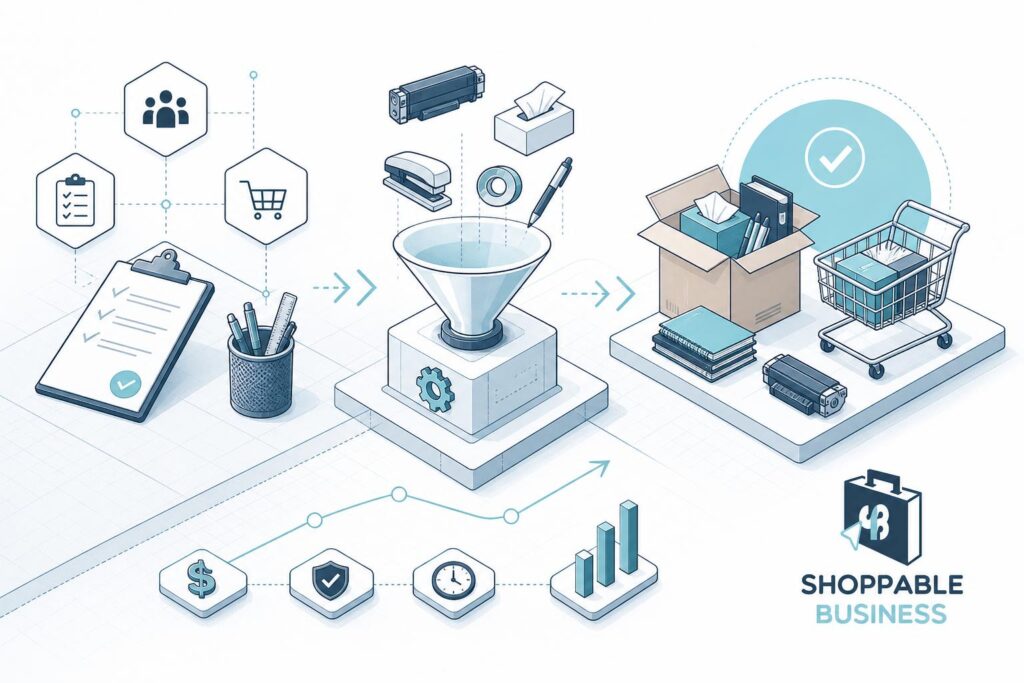
Most companies don’t think about how they buy pens, paper, and printer toner until they realize they’ve spent a small fortune on it. Office supplies feel like a minor line item, but across dozens of employees and twelve months, the numbers add up fast. A Philippine BPO with 200 seats, for example, can easily burn through PHP 1.5 million a year on supplies alone, and that’s before you count the wasted hours spent chasing purchase orders, reconciling receipts, and dealing with three different vendors for the same category of products.
The real cost isn’t just the supplies themselves. It’s the invisible drain: duplicate orders, expired stock sitting in a closet, maverick spending where employees buy whatever they want from wherever they want, and zero visibility into where the budget actually goes. Streamlining how you handle office supplies procurement isn’t glamorous work, but it’s the kind of operational improvement that directly hits your bottom line. Whether you’re a 10-person startup or a 500-seat operation, the principles are the same. Get clear on what you’re actually using, simplify your vendor relationships, bring in the right tools, organize your physical space, and keep measuring. Here’s how to do each of those things well.
Best Practices in Office Supplies Procurement
Auditing Current Inventory and Consumption Patterns
Before you change anything about how you buy supplies, you need an honest picture of what’s happening right now. Most companies skip this step because it feels tedious, but every improvement you make downstream depends on accurate data. A proper audit doesn’t need to take weeks. Set aside two to three days, grab a spreadsheet, and physically count what’s in your supply rooms, desk drawers, and storage closets. You’ll almost certainly find surprises: boxes of items nobody uses anymore, shortages of things people actually need, and duplicates purchased because no one knew the first batch existed.
Identifying High-Volume vs. Low-Use Items
Sort your inventory into two buckets. High-volume items are the things you reorder constantly: copy paper, ballpoint pens, sticky notes, printer cartridges, and cleaning supplies. These are your bread-and-butter purchases and should account for 60-70% of your total spend. Low-use items are the specialty purchases that show up once or twice a year: binding supplies, presentation folders, whiteboard markers for a conference room nobody uses.
The goal here is to know exactly which items deserve bulk purchasing attention and which ones you can order on demand. If you’re buying laminating pouches in bulk but only using ten a quarter, that’s dead capital sitting on a shelf.
Analyzing Historical Spend and Budget Leakage
Pull your purchasing records from the last 12 months. Look at every receipt, invoice, and reimbursement claim related to office supplies. You’re hunting for patterns: which months spike, which departments overspend, and where money leaks out through informal purchases. Budget leakage typically comes from employees buying supplies out of pocket and expensing them, orders placed outside the approved process, or rush deliveries that carry premium shipping fees.
One mid-sized eCommerce company in Cebu discovered that 22% of their annual supply spend came from reimbursement claims, meaning employees were buying things on their own because the internal ordering process was too slow. That’s a system problem, not a people problem.
Consolidating Vendors and Standardizing Products
Spreading your purchases across five or six suppliers might feel like you’re getting the best price on each item, but it almost always costs more in the long run. Every vendor relationship carries administrative overhead: separate invoices, different payment terms, multiple points of contact, and no volume leverage. Consolidation is where serious savings begin.
Negotiating Bulk Discounts with Primary Suppliers
Once you know your high-volume items, you’re in a strong position to negotiate. Approach your top one or two suppliers with actual consumption data and ask for volume pricing. Most suppliers will offer 10-20% discounts on committed monthly or quarterly volumes.
This is where working with a single-supplier platform like Shoppable can make a real difference. Instead of negotiating separately with a paper supplier, a toner vendor, and a cleaning supplies distributor, you consolidate everything through one procurement channel. Shoppable’s Procurement as a Service model lets you source everything from IT peripherals to basic office supplies through a single supplier on record, which simplifies your accounting and gives you better pricing through aggregated volume. You also get BIR-certified sales invoices for every transaction, which keeps your finance team happy during tax season.
Creating a Pre-Approved Product Catalog
Standardization sounds boring, but it eliminates one of the biggest procurement headaches: choice overload. When every department can order any brand of pen, notebook, or folder they want, you end up with fragmented purchasing and zero leverage.
Build a catalog of 50-100 pre-approved items that cover 90% of your office needs. Include two or three options per category (a standard pen and a premium pen, for instance) and make this the only list employees can order from without special approval. Update the catalog quarterly based on feedback and consumption data.
Implementing Digital Procurement Software
If your current process involves email chains, paper forms, or someone walking to a supply closet and writing items on a whiteboard, you’re losing time and money every single day. Digital procurement tools have become affordable enough that even companies with 15 employees can justify the investment. The right platform pays for itself within three to six months through reduced maverick spending and better inventory control.
Automating Reorder Points and Stock Alerts
Set minimum stock levels for your high-volume items and let the system alert you when it’s time to reorder. This eliminates two common problems: running out of critical supplies (which triggers expensive rush orders) and over-ordering because someone panicked when they saw the paper stack getting low.
A good rule of thumb for setting reorder points: calculate your average weekly consumption, multiply by your supplier’s lead time in weeks, and add a 20% buffer. If you go through 10 reams of paper per week and your supplier delivers in 3 business days, your reorder point is about 8 reams (roughly one week of stock plus buffer). A centralized platform like Shoppable provides spending visibility and budget control tools that make this kind of tracking straightforward, especially for companies managing supplies across multiple office locations or remote teams.
Centralizing Approval Workflows
Every purchase request should follow a clear path: requester submits, manager approves, procurement places the order. Digital workflows make this happen in minutes instead of days. The key is keeping the approval chain short. For standard catalog items under a set threshold (say PHP 5,000), a single manager approval should be enough. Reserve multi-level approvals for non-catalog or high-value requests.
This structure prevents two extremes: the free-for-all where anyone can order anything, and the bureaucratic nightmare where buying a box of staples requires three signatures and a week of waiting.
Optimizing On-Site Storage and Distribution
You can have the best procurement process in the world, but if your supply room is a disaster, you’ll still waste time and lose track of inventory. Physical organization is the unglamorous cousin of digital procurement, and it matters more than most people think.
Organizing Supply Rooms for Visual Management
Borrow a page from warehouse management. Label every shelf and bin clearly. Group items by category (writing supplies, paper products, cleaning materials, tech accessories) and use a first-in, first-out system so older stock gets used before newer deliveries. Clear plastic bins work better than opaque boxes because anyone can see at a glance what’s running low.
Post a simple inventory sheet on the door or wall that gets updated weekly. This doesn’t need to be fancy. A printed spreadsheet with item names, current quantities, and reorder points is enough. The visual element matters because it turns inventory management from an abstract task into something concrete and obvious.
Consider a sign-out system for high-value items like printer cartridges or specialty paper. A simple logbook (or a shared Google Sheet) where employees note what they took and when creates accountability without adding bureaucracy.
Designating Procurement Leads by Department
Don’t make procurement everyone’s job, because that means it’s nobody’s job. Assign one person per department (or per floor, for larger offices) as the procurement lead. This person collects supply requests from their team, submits consolidated orders through the approved system, and manages their department’s supply area.
This role shouldn’t take more than 30-60 minutes per week. The procurement lead doesn’t need to be a senior employee: often an admin assistant or office coordinator is the ideal fit. What matters is that there’s a clear point of contact so requests don’t fall through the cracks and duplicate orders don’t happen because two people from the same team submitted the same request independently.
Monitoring Performance and Continuous Improvement
Setting up a good procurement system is only half the battle. The other half is making sure it keeps working. Without regular check-ins, even the best processes degrade over time as people find workarounds, new employees skip training, and vendor pricing creeps up.
Reviewing Monthly Compliance Reports
Track three numbers every month: total supply spend versus budget, percentage of orders placed through the approved system (compliance rate), and average order-to-delivery time. If your compliance rate drops below 85%, you have a process problem that needs attention. Either the system is too difficult to use, approval times are too long, or employees don’t understand the process.
Monthly reviews don’t need to be long meetings. A 15-minute check-in between your procurement lead and finance team is enough. Look at the numbers, identify any anomalies, and address them before they become habits. If one department consistently overspends, dig into why. Maybe their headcount grew and the budget wasn’t adjusted, or maybe they’re ordering non-catalog items that should be added to the approved list.
Evaluating Sustainability and Eco-Friendly Alternatives
Sustainability in procurement isn’t just a feel-good initiative anymore: it affects your brand reputation, your compliance with evolving Philippine regulations, and increasingly, your costs. Recycled paper, refillable ink cartridges, and biodegradable cleaning supplies have reached price parity with conventional alternatives in many categories as of 2026.
Review your catalog every quarter and look for eco-friendly swaps that don’t compromise quality or increase cost. Start with the easy wins: recycled copy paper, refillable whiteboard markers, and plant-based cleaning products. Track the percentage of your catalog that meets sustainability criteria and set a target to increase it by 10-15% each year.
Making Procurement a Strength, Not a Headache
Getting your office supplies procurement right won’t make headlines, but it will free up budget, reduce frustration, and give your operations team fewer fires to put out. The companies that do this well share a few traits: they know exactly what they’re spending, they buy from fewer suppliers on better terms, they use digital tools to enforce process discipline, and they review performance regularly.
If you’re running a BPO, SME, or growing enterprise in the Philippines and you’re tired of the chaos that comes with managing multiple vendors and chasing invoices, platforms like Shoppable can consolidate your entire supply chain into one relationship, complete with flexible 30-day payment terms and end-to-end logistics support. Start with an audit of what you’re buying today, and build from there. The savings will show up faster than you expect.